Tigers gotta eat, even in a Rochester winter.
RIT is home to more than 20,500 students, including roughly 3,000 international students from over 100 countries, plus thousands of faculty and staff, and a campus full of dining options. The catch is how you get to them. The RIT Dining app lets you order ahead, but the only way to actually receive your food is to show up at the counter and pick it up.
Now add a Rochester winter: 70 to 120 inches of snow a year and an average temperature around 28°F. For the roughly 7,500 people who live on or near campus, "just go grab it" stops being realistic for months at a time. There's no doorstep delivery, so the gap sits exactly between RIT's dining and a student's comfort.
Secondary research backed up what the weather suggested:
Who we talked to, and what the snow revealed.
We didn't want to assume the demand. We went and measured it. The team ran 12 interviews and 75 surveys across the RIT community, plus contextual inquiry and on-site observation at three of the busiest dining locations: Brick City Cafe, Cantina, and The Commons. The interviews deliberately spanned both sides of the counter, students who order, and the people who fulfil: three student dining employees, two on-demand service staff, an RIT Dining manager, an IT admin, and four students who live on and off campus.
We dug into the things that actually shape a delivery service: where people live (dorms versus nearby apartments like Apex, Province, and Park Point), how often they order, whether they order solo or in groups, their budgets and preferred payment methods, how fast they expect food to arrive, and where they'd want it dropped.
The operational path for delivery half-existed already: the missing pieces were a delivery role and an interface to run it.
A pilot study made that concrete. Observing the "on-demand" servers, the people who hand out pickup orders, showed they had spare capacity and could act as the coordination point for handing orders to a delivery person. And interviewing a Brick City Cafe employee pinned the timing: assembling an order takes about 5–10 minutes before it goes into a hot box. So the kitchen flow was ready; what RIT Dining lacked was the delivery layer on top of it, and that's where the design focused.
A delivery layer, not a new app.
RIT EATS was a team project, six of us in Team Athens, built for a graduate HCI course. The biggest framing decision came early: rather than invent a standalone food app, we designed delivery as an extension of the infrastructure RIT already runs, so it could plug into RIT Dining and the RIT Mobile app instead of competing with them.
I was the Website Designer on Team Athens. I owned the brand and visual side: the RITEATS identity, the "Tigers gotta eat" motif and burger-forward direction in the title slide, and applying RIT's official palette and visual system across the hi-fi designs. The research and the broader product were a team effort. (Palash, confirm this is the right line. If you also designed specific app screens or ran part of the research, tell me and I'll credit it precisely.)
Before settling on a direction, the team weighed three ways to actually move food across campus:
In-app delivery to your locationchosen
Add delivery into the existing RIT Mobile app, fulfilled by student workers split into on-foot, cyclist, and driver roles depending on distance and weather.
Partner with a third party
Collaborate with an existing campus-delivery service like BYPPO (used at the University of Florida) and lean on their logistics.
Deliver to a nearest hotbox
Drop orders into a per-building hotbox unlocked by a QR code, with a scale to track contents (lower staffing, more hardware).
The heavy operational layer: real routing, the hotbox hardware, third-party contract terms, and the ordering back-end. We designed the in-app experience and the new delivery role around it, and assumed those services could be stood up, because the goal was to prove the experience, not to build RIT's logistics.
Order on one side, deliver on the other.
The prototype is a two-sided product: the same app serves the student placing an order and the student employee delivering it. That's what makes the service actually run, instead of just looking good on the ordering screen.
Order & track
- Browse campus spots (Brick City Cafe, Ritz, Cantina) with dish detail, customization, and allergen flags
- Cart and checkout with Dining Dollars, Tiger Bucks, Apple Pay, or card
- Real-time order tracking with status and the delivery person's name and contact
- Profile, wallet and transactions, customer support, and accessibility tools (text size, theme, contrast, language)
Pick up & deliver
- See assigned orders and start a delivery with map guidance
- Contact the customer for drop-off instructions, then confirm delivered
- Manage shift timing and availability
- Report issues and review delivery history and ratings
Here's the user side, screen by screen, from the first tap to a delivery you can watch arrive.
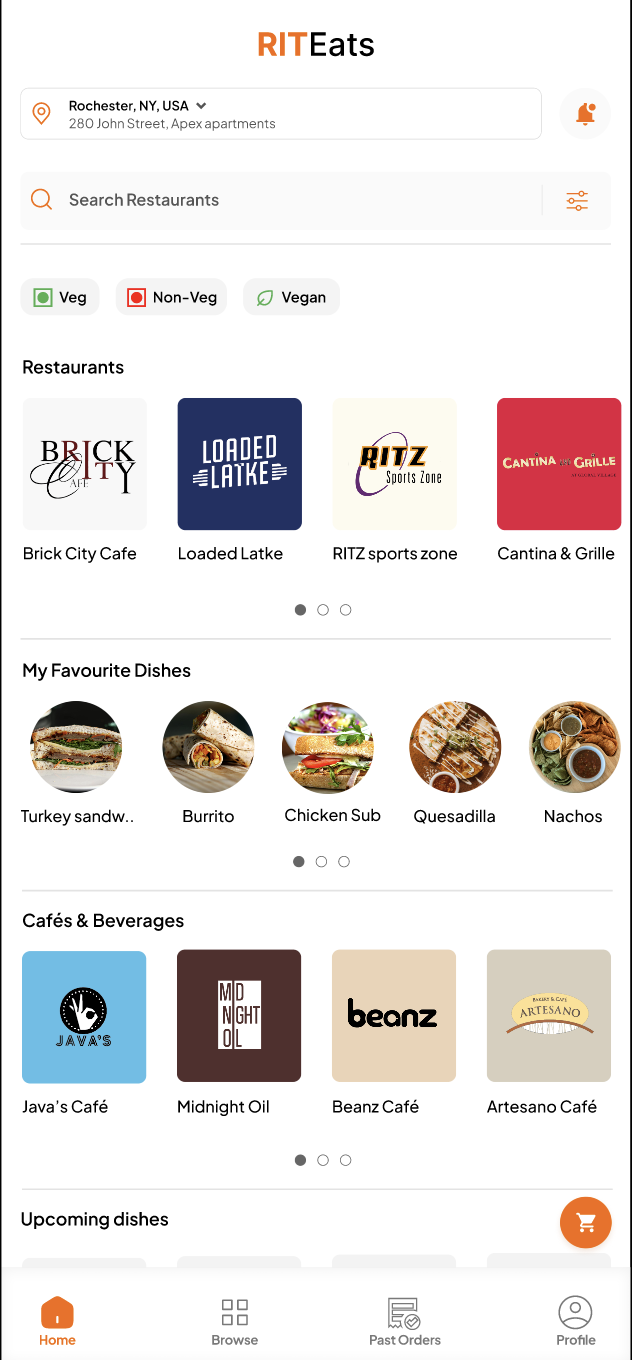
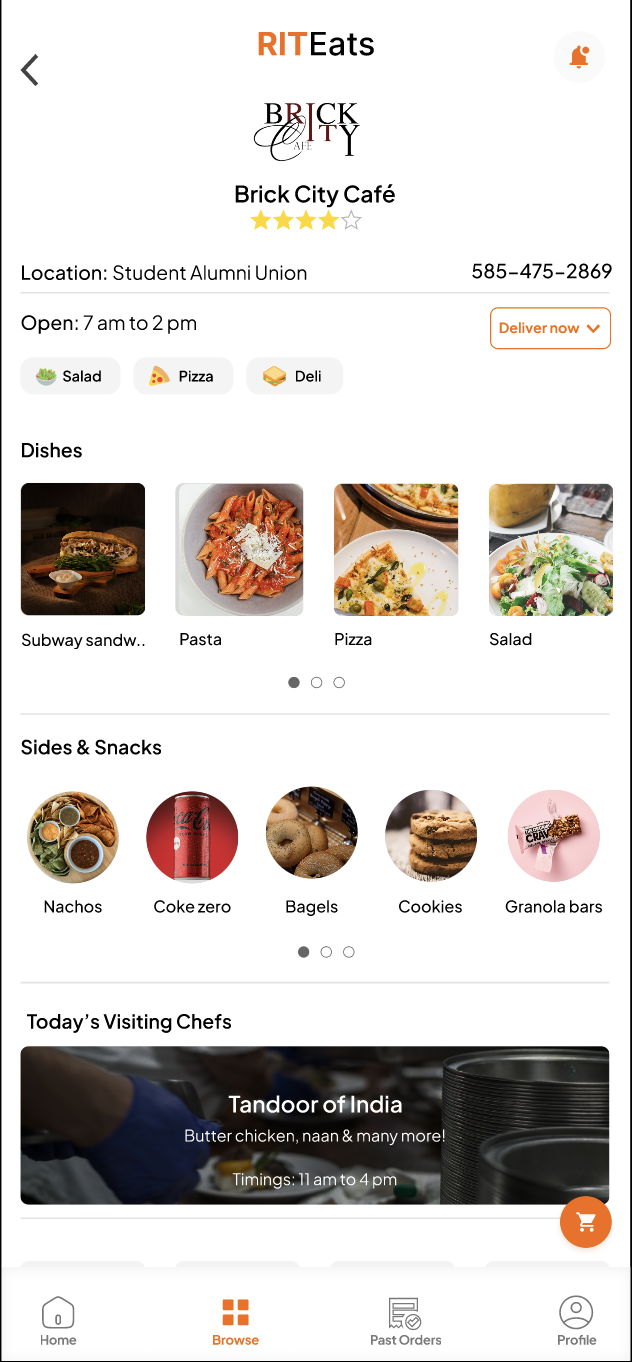
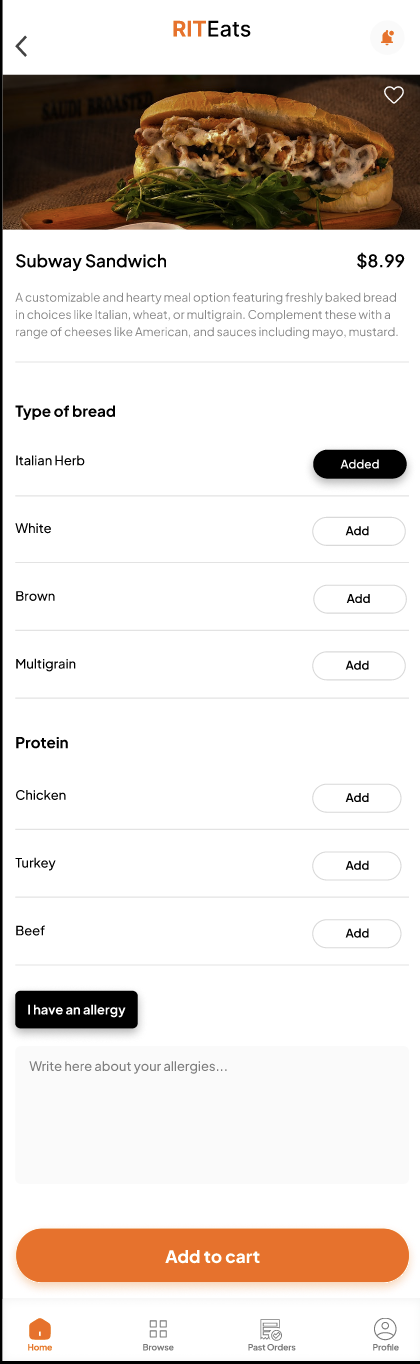
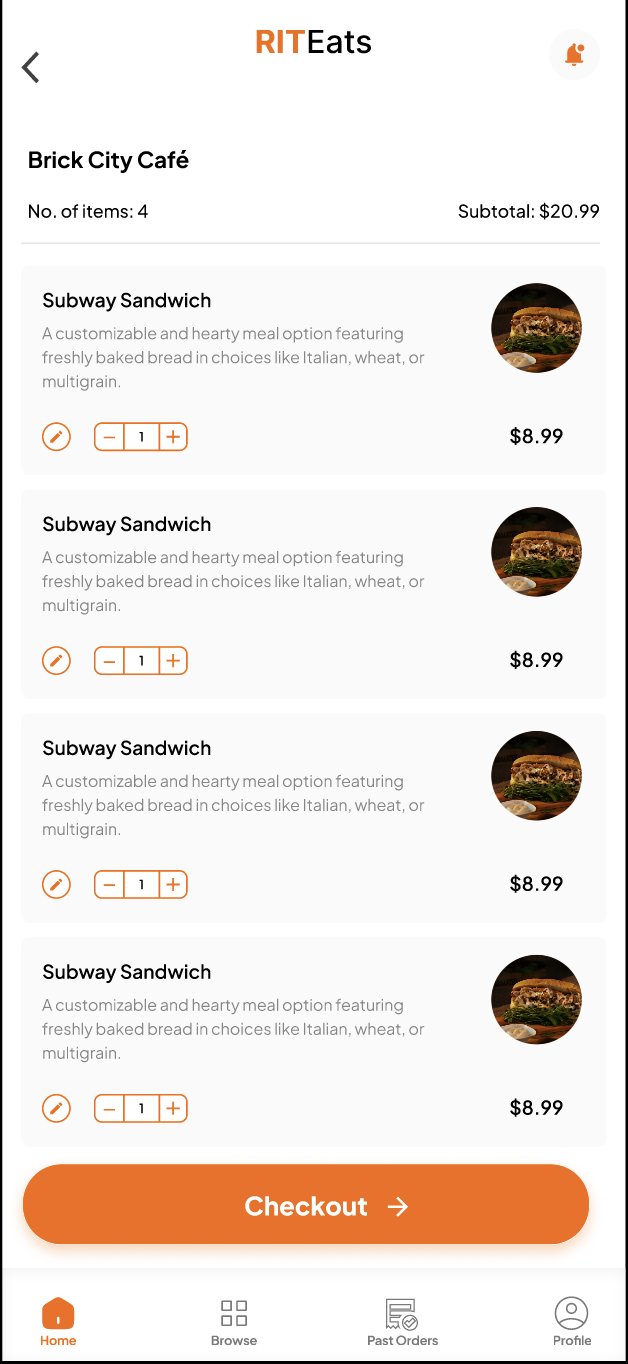
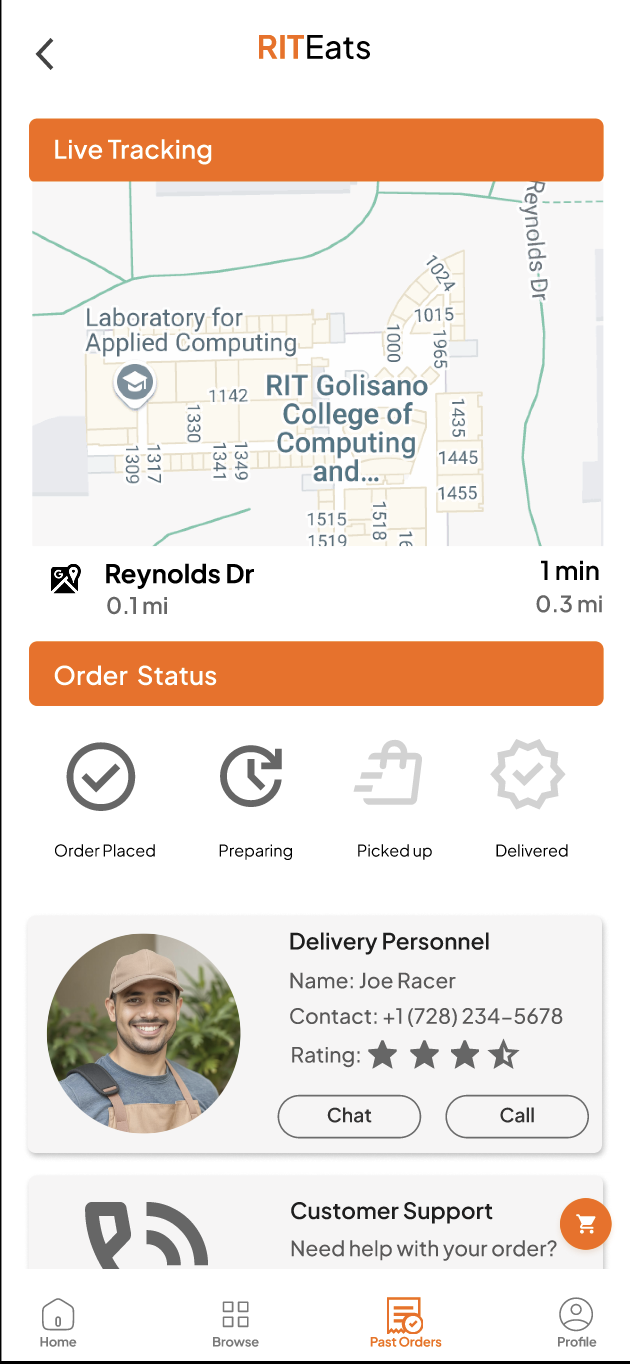
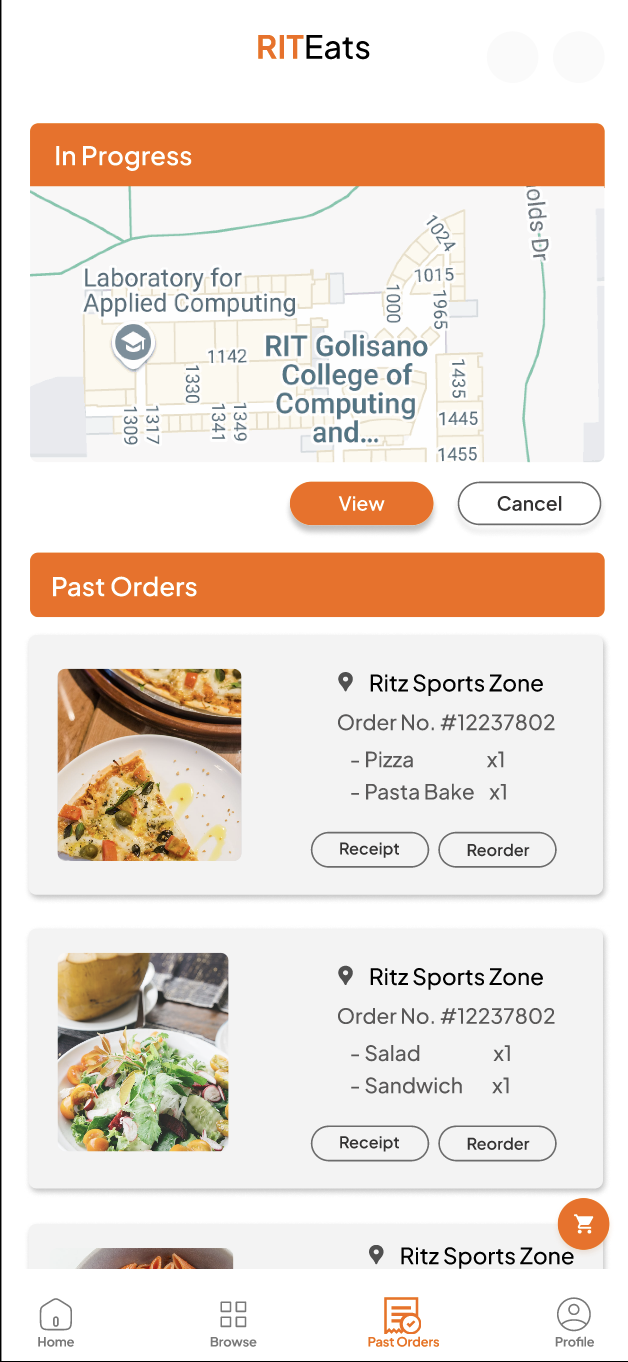

A delivery service only works if the person delivering has tools too. Design just the customer side and the operation stalls. So we built a dedicated delivery-personnel experience alongside the user app, where orders, routing, shifts, and issues all live in one coherent system.

Beyond ordering, the app carries the rest of campus life: a wallet with campus payment methods, support, and a dedicated accessibility suite (font size, themes, contrast, and language) so it works for everyone.
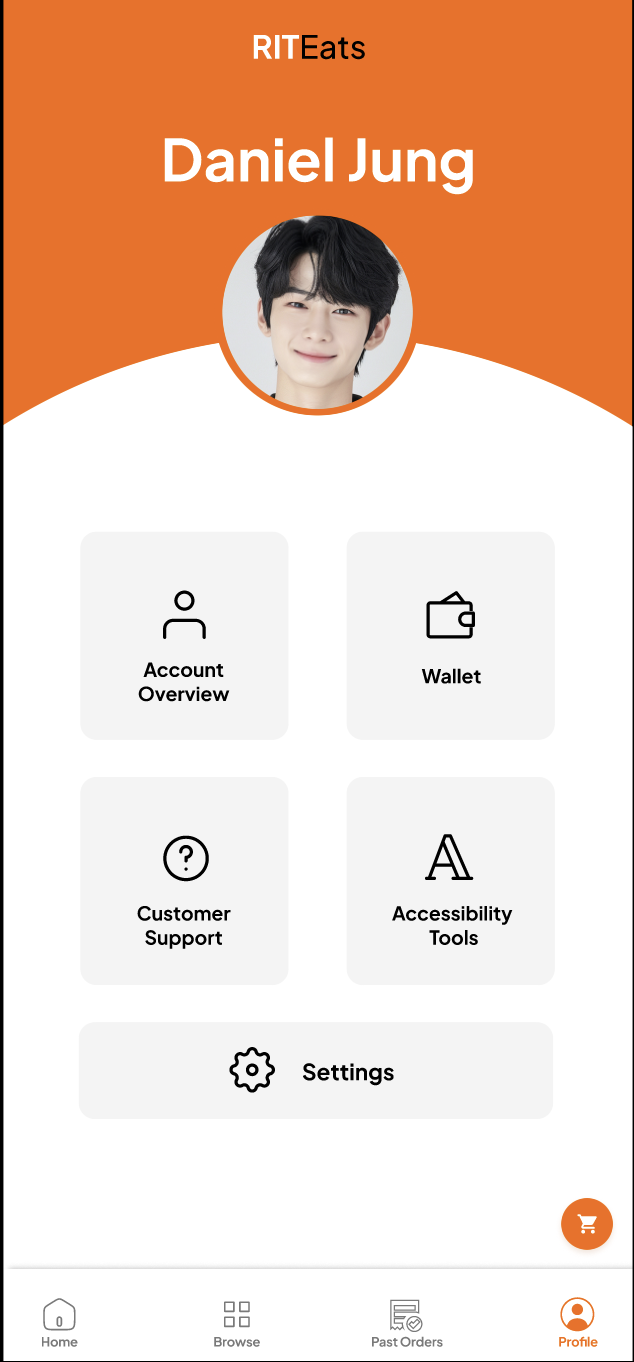
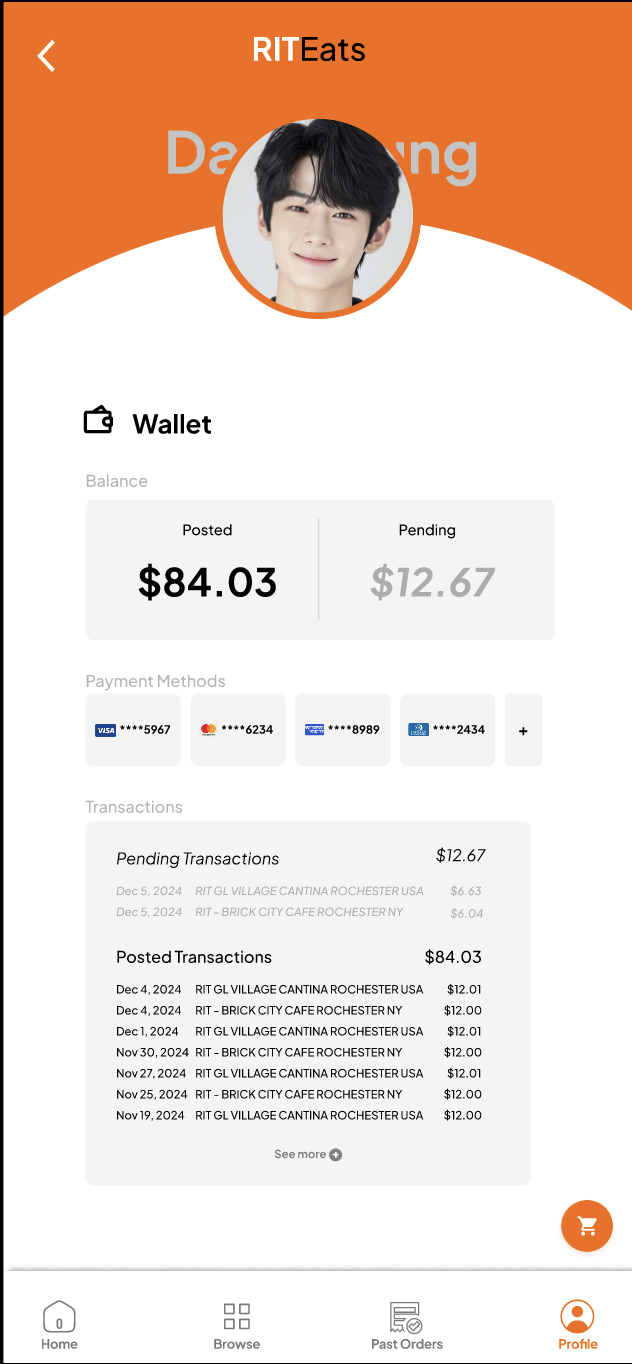
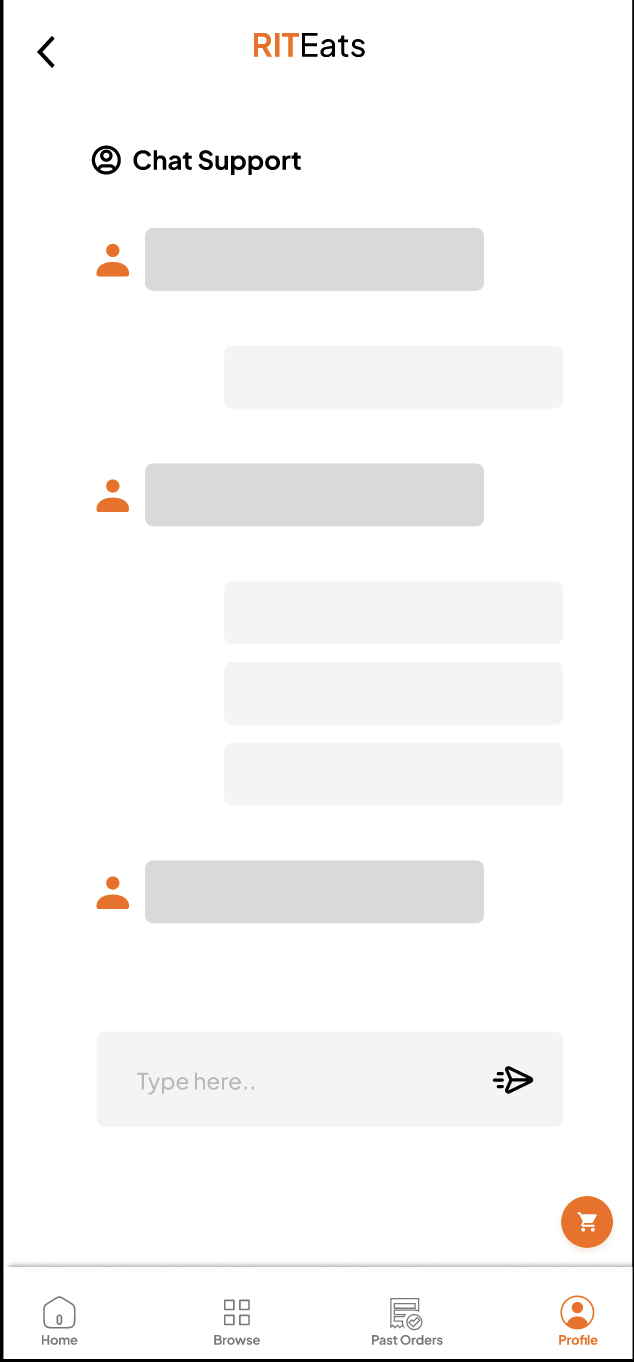
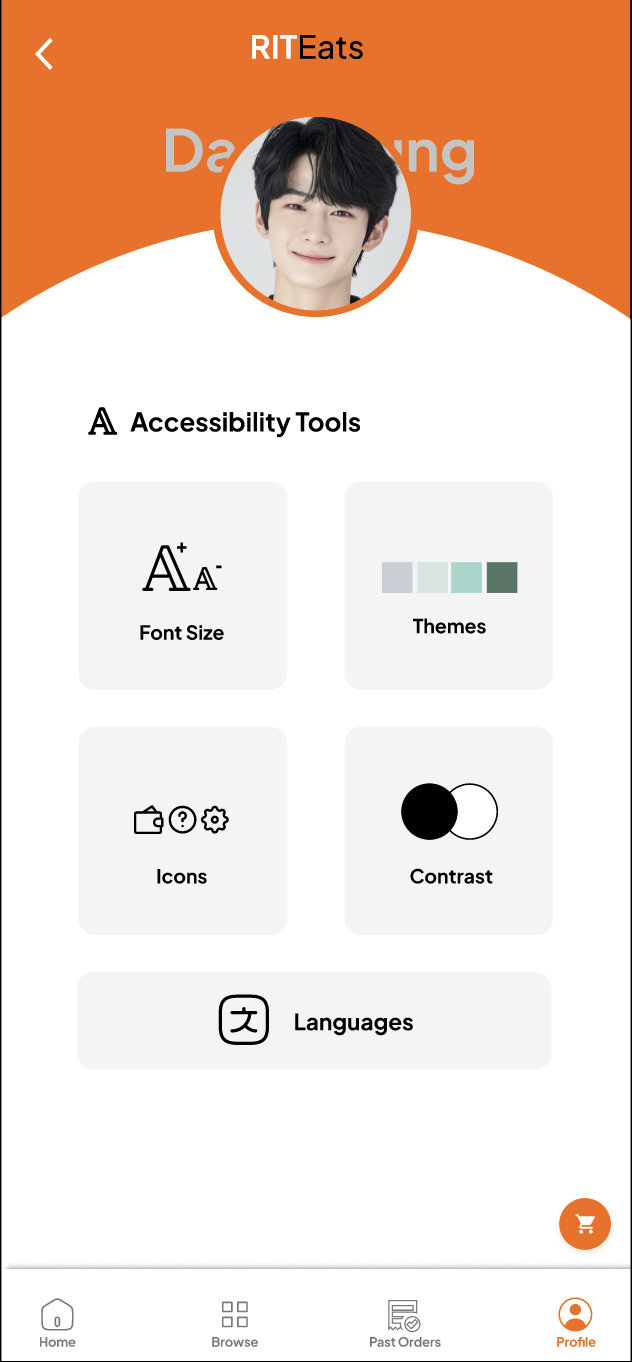
On the visual side, going from lo-fi to hi-fi meant making the product feel unmistakably RIT: the official palette applied across buttons, backgrounds, and accents, a clear icon set, accessible type and contrast, and depth through shadows and layering to guide focus. The result is the branded, cart-driven interface shown in the screens above.
A working concept, and where I'd take it next.
RIT EATS is a graduate-course concept that Team Athens carried from a real, locally-grounded problem all the way to a hi-fi, interactive prototype, complete with a usability-test script written to put it in front of both students and delivery staff. It's a concept, not a shipped product: we designed the experience and the new delivery role, and assumed the logistics services behind it could be built.
Where I'd take it next is the half we deliberately left out: run the usability sessions we scripted, then design the operational layer for real: routing, the hot-box-versus-driver trade-off, and the hand-off between the kitchen and the delivery person. The business case is already there: done well, delivery turns bad-weather demand into orders RIT Dining would otherwise lose, and into student jobs.
What it taught me
How to design within a real institution's brand and systems, on a team, and that a service is only as good as the side of it nobody sees: the people fulfilling the order.